ZEEF: 7 Essential Resources & Tips to Get Started with UX
Hi, I’m Alexander Kluge, the curator of the ZEEF UX page.
I’m a remote worker and co-creator of the Colombian startup ON BOARD, an alternative education and travel program for small groups traveling 3–30 days in a selected country, learning from locals, seeing the country through their eyes and initiating transformative processes to benefit the local economy, communities and our participating travelers.
I’m also the founder of Free Write Camp where you practice your writing in creative and hands-on writing exercises, and Coastery Camp, a writing retreat with workshops camping at the coast.
In this article I’ve compiled a collection of 7 essentials (taken from my ZEEF page) to get you started with UX.
1: What is UX?
UX is User Experience and cares about business goals and people’s desires using the product, website, app or service, especially in terms of ease and pleasure of use — which is why it is tightly connected to usability. It is often (not always) related to digital experiences in the web and apps.
“User experience” encompasses all aspects of the end-user’s interaction with the company, its services, and its products. — Nielsen Norman Group
UX is generally an interdisciplinary field and not something you do (or a verb). Therefore it comprises aspects of media design, computing, computer science, psychology, culture, marketing, usability and much more (see resource 2).
The basic foundation to understand UX is to put the user (human person) into the center of the design process, in a user-centered design (UCD) approach.
The term is widely and frequently used which makes people confuse it with UI design (see resource 5):
Too often, UX is narrowly defined as one of the many disciplines that make up UX as a whole (e.g., wire framing, information architecture, etc …). On your next project, if you’re asked to “UX it,” stand up for yourself and kindly explain that UX is a holistic process. It’s not a box you can tick off a to-do list. — Tim R. Todish (UX Magazine)
2: The Disciplines of UX
You will often find the term UX Design (UXD), not solely UX, because people talk about the actual creation (design) of experiences. So it makes sense to use the term UX Design. You can see it applied in the diagram by Dan Saffer which shows the disciplines of user experience design.
It’s still not perfect: it’s missing Sound Design and Ergonomics/Human Factors, and the way the circles had to overlap downplays Visual Design. […] HCI is partially out of the circle because of its different (non-design) traditions and methodologies, and also because of its focus on pure research. Industrial design (and, in truth, architecture should do this too), pokes out of the circle because it has involvement in areas that do not directly involve the user, such as manufacturing (or in the case of architecture, building) specifications. — Dan Saffer (Kicker Studio)
3: The Elements of User Experience
As part of his book “The Elements of User Experience” Jesse James Garrett made a crucial contribution to the web world. He differentiates the web as a software (interaction) and a hypertext system (information) – both exist at the same time non-isolated from each other.
UX, according to Garrett, puts the user needs and business objectives first in the design process. They are followed by functional and content specifications to eventually design the information, navigation, interface and visual appearance.
4: The Fundamentals of Experience Design
From a broader perspective, “designing (for) experiences is fundamentally about people, activities, and the context of those activities.”, Steven P. Anderson says.
The interesting observation is the dimension Anderson applies when he doesn’t talk about users but people, and activities and their context, not business owners with their goals. It widens one’s point of view because a whole ecosystem is affected by the the experience (see resource 7), not only two parties (users and businesses).
5: The Difference between UX and UI Design
Design is how it looks, feels and works (as by Steve Jobs famously said). While you learnt above that UI/interaction design is part of the whole UX process a short way to differentiate both could be:
You can have an application with a stunning design that is hairy to use (good UI, bad UX). You can also have an application that has a poor look and feel, but is very intuitive to use (poor UI, good UX). — Onextrapixel
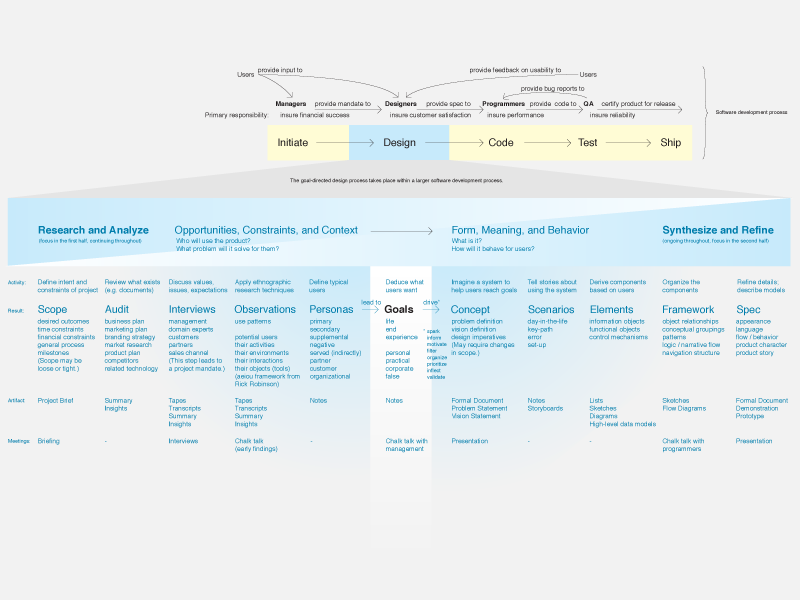
6: The Cooper Goal Directed Design Process
Reading the goal-directed process Alan Cooper developed can feel overwhelming. Hence, it is very insightful and valuable for more in-depth explorations when you have the goal to create a mindset directed towards human-centered design.
Basically, you find one person, understand their vision and their final desired end state, and then make them ecstatically happy about reaching their end state. That is the essence of Goal-Directed Design. — Alan Cooper
And continues saying:
And what you need are two things: 1) Find (or synthesize) the right person and 2) Design for that person. At a place like Apple, Steve Jobs was already that right person, and they needed look no further. See here the whole goal-directed design process. — Alan Cooper
7: About Face: The Essentials of Interaction Design
For many the most important book and crucial reading in order to profoundly understand designing experiences for the digital age is ¨About Face: The Essentials of Interaction Design” by Alan Cooper. It covers topics like:
- Understanding Goal-Directed Design (see resource 6)
- Designing Behavior and Form
- Designing Interaction Details
Conclusion
The next level of UX is human story experience design (HSXD) combining the lessons learnt from designing experiences with the power of (transmedia) storytelling and story-writing.
More UX? Explore my ZEEF page for more hands-on articles, guides, tutorials and blogs, there is still tons of UX information to discover. (You can also contribute to the page by suggesting other quality UX links).
Ready for some German? I offer two scientific papers to read for free:
- Tweet or download without tweet: “UX of Text Adventures in Theory & Practice”,
- Tweet or download without tweet: “Introduction to Transmedia Storytelling”